Story of the day, Bay Area Tracking Club, Nov 9th, Gazos Creek State Beach
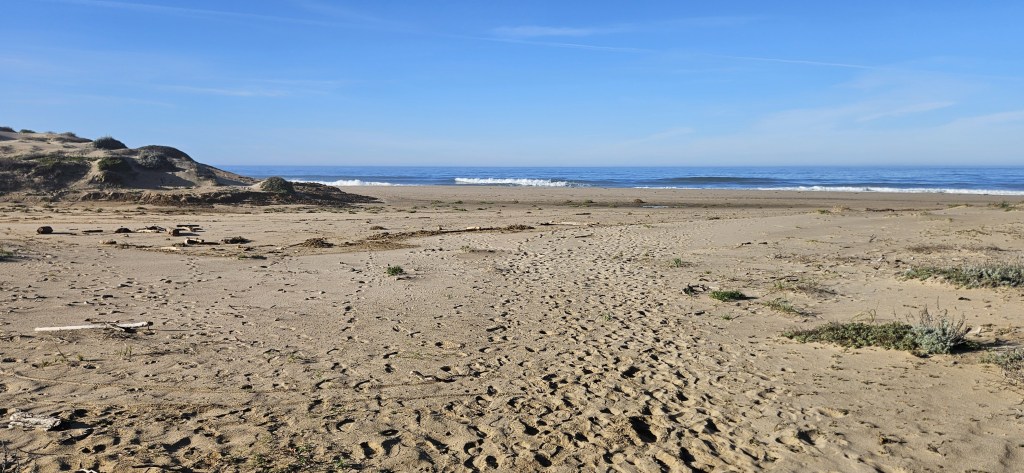
A small group of trackers gathered at Gazos Creek State Beach, greeted by clear skies and a promising start to the day. A few Acorn members scouted the beach at both ends, and after a brief discussion, decided the southern end held more potential for tracking. A couple of the group members kindly offered a ride, and we carpooled to the site.
Barely onto the trail, we encountered our first puzzling clue: a piece of scat. Whose was it? We carefully examined it, noting the absence of thick fur or vegetative material, though there were some hairs. The scat had a uniform, grainy texture typical of dry food, often fed to domestic dogs. A few yards further, we found another scat—this one from a wild canine. We couldn’t definitively identify whether it belonged to a coyote or a fox, but we kept it in mind as we moved on.
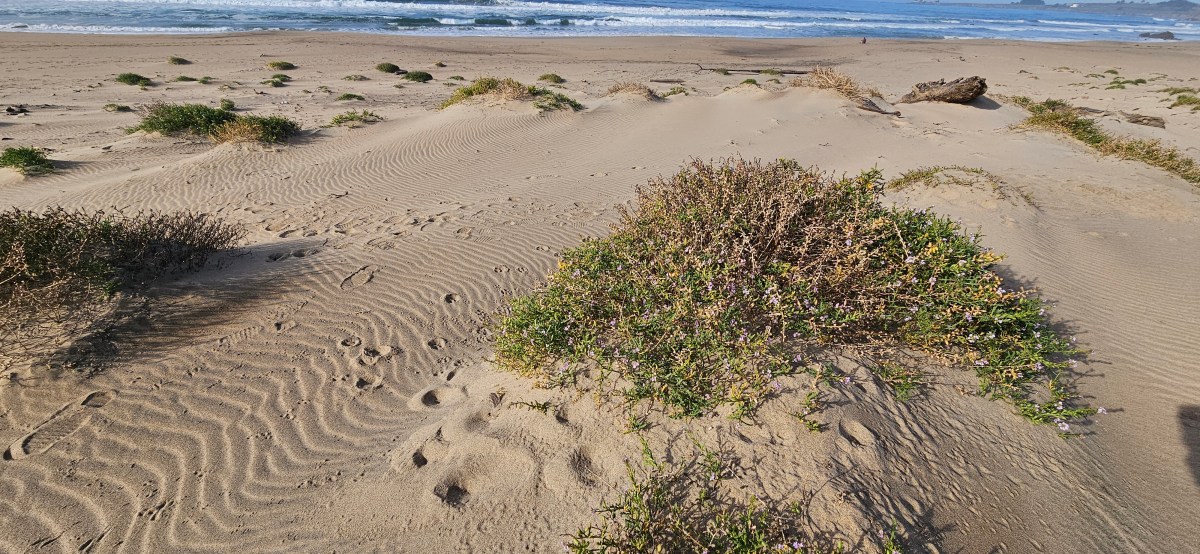
A short distance ahead, we found canine tracks—some with prominent, blunt claws—suggesting they might be from our original scat maker. When we stepped onto the beach, we were struck by the high tide line, which had deposited piles of debris far up onto the sand. The recent Beaver Moon had created unusually strong tidal forces, sweeping large sections of the beach clean. It was the perfect canvas for animal tracks.
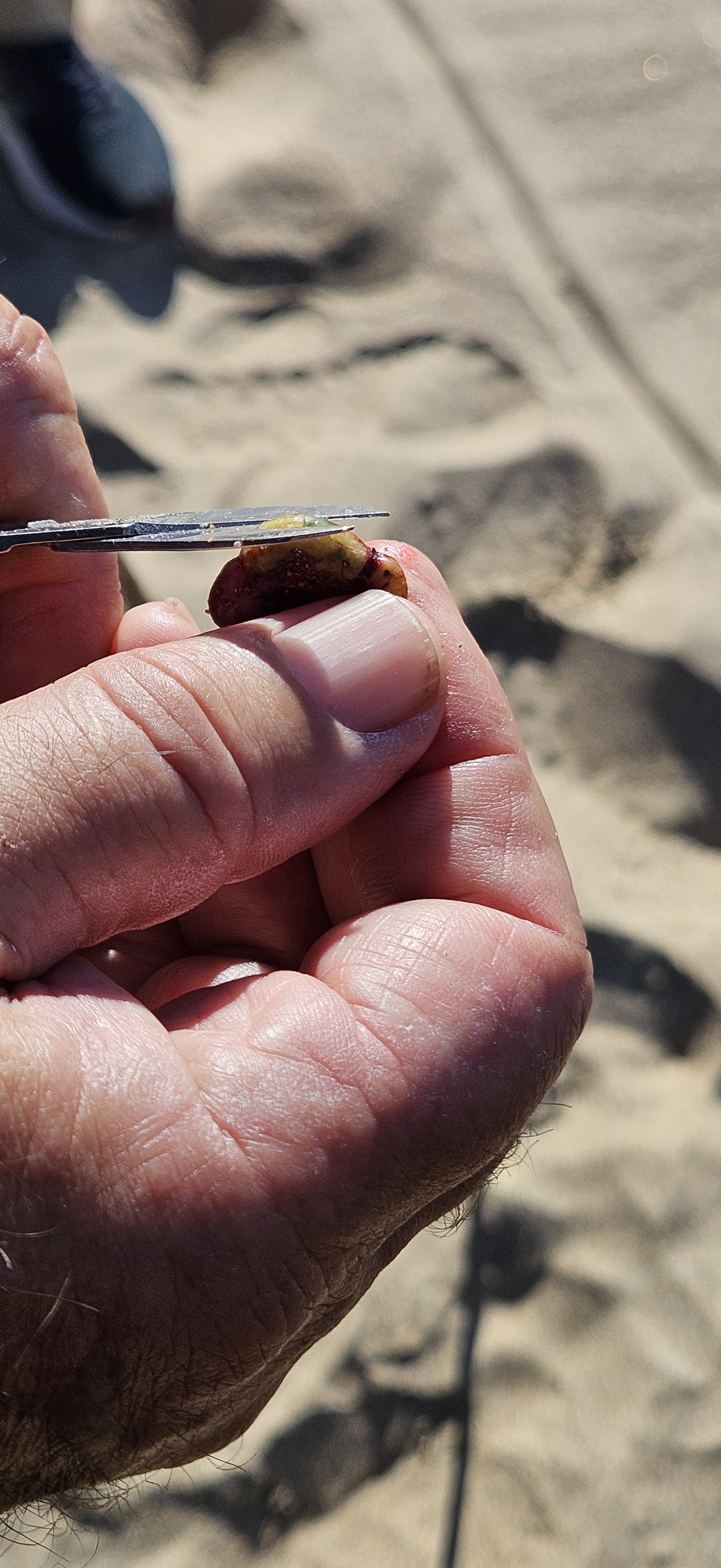
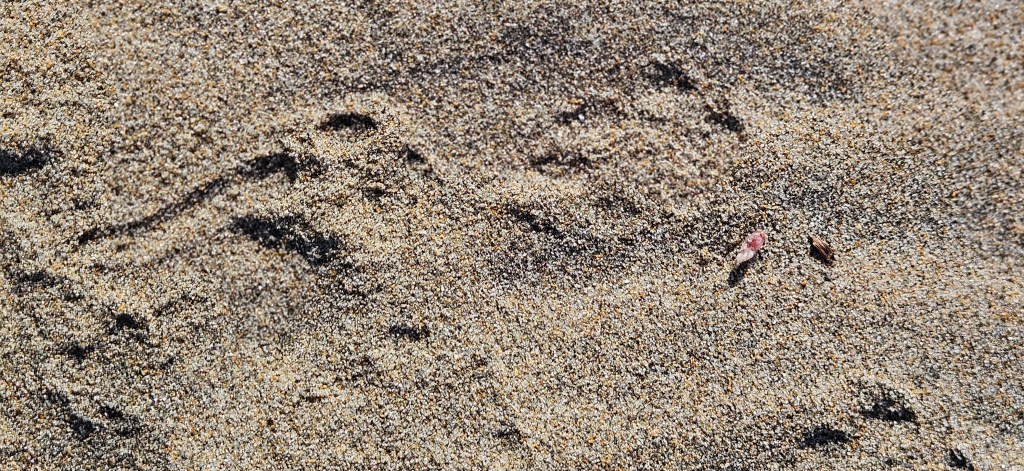
Further up, on the dunes, we encountered a fresh mystery: signs of predator-prey dynamics. Among several feline tracks, there was an impression of a cat sitting on its haunches, with tracks just in front of it and a small organ—roughly the size of my thumbnail. The organ, a liver, was dark red, while the stomach had a greenish hue and contained partly digested sea rocket seeds. The cat had processed its prey with meticulous precision, much like Garth described witnessing a house cat methodically separating unwanted organs from its kill.


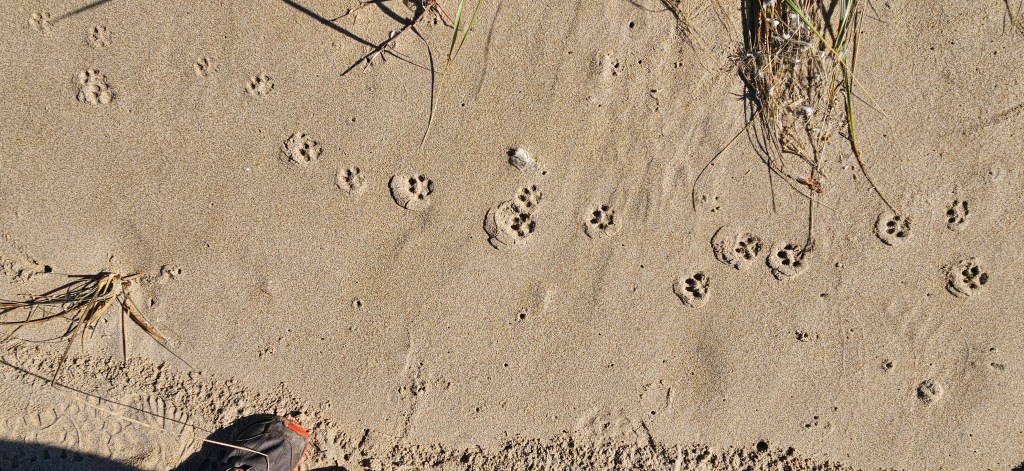
The identity of the cat was unclear. Its front tracks measured around 1.5″ x 1.5″, with the hind tracks just an eighth of an inch narrower—small for a bobcat. Could this be the same cat we’d observed months earlier on the opposite side of the beach? Regardless, this cat seemed highly familiar with the landscape. If it was a house cat, it was an intrepid one, coexisting with coyotes and bobcats—predators that would have no hesitation turning it into a meal. We backtracked it through the dunes, eventually finding a gentle slope that led down to the southern section of the beach. Here, we followed the feline tracks along a cliff, wondering if this was one individual retracing its steps or two distinct cats.

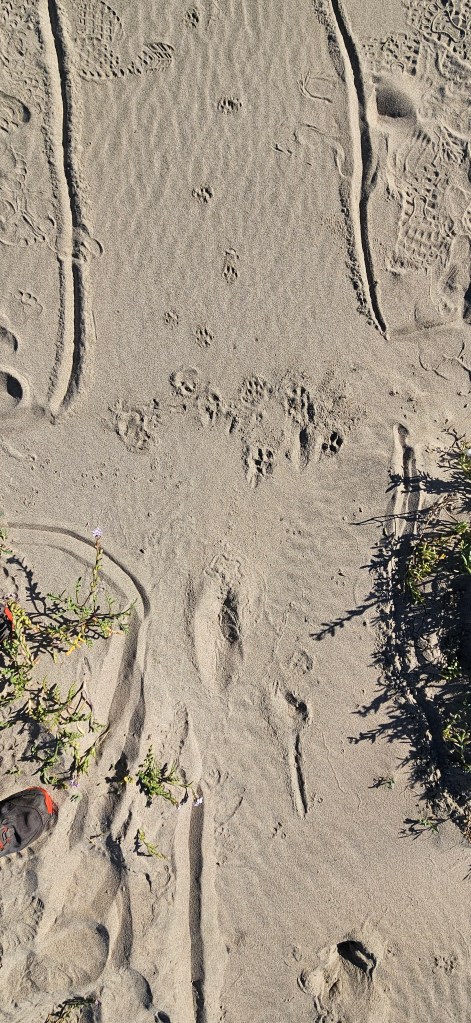
By then, four other trackers had joined us. We studied several canine track patterns and discussed the gaits they represented—how the type of movement an animal uses can often be deduced from the track patterns it leaves behind. One of the smaller canines had prominent claws and tended to leave one of its tracks to the side. Was this a sign of a head turn, or perhaps arthritis? A little further, we observed the same animal transitioning into a gallop, with very short distances between the track sets—perhaps an older, overweight dog.
We also encountered coyote tracks that revealed an interesting gait pattern. The hind feet consistently landed ahead of and to the side of the front feet, creating parallel diagonal pairs of tracks. This was a side trot, common for coyotes and other canines (though not gray foxes), which allows them to trot with speed. One tracker suggested that, on an angled surface like the beach, the coyote might angle its body so that its longer hind feet naturally land below its centerline of travel—something to keep in mind for future observations. We also discussed whether the pairs of tracks corresponded to the same side of the body—left front next to left hind, and right front next to right hind. It’s a fun and challenging exercise you can even try in your living room!

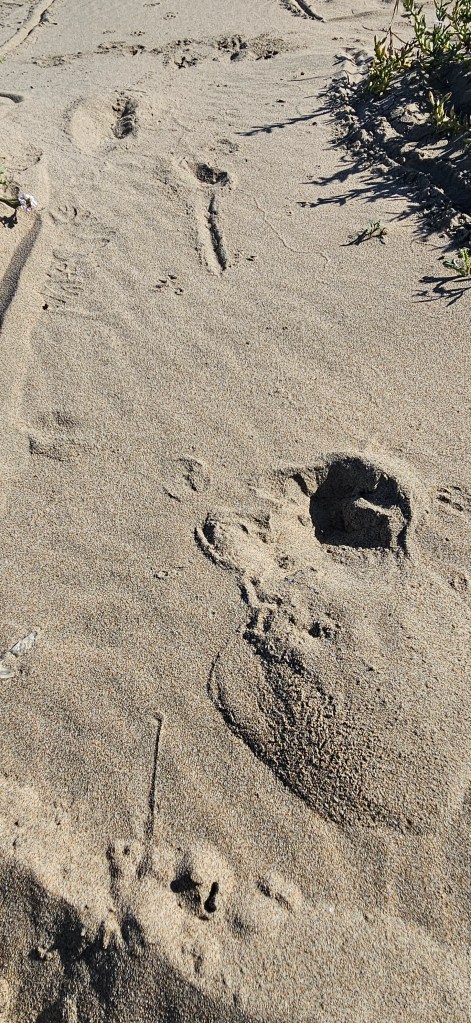
As the day wore on, we had one last mystery to investigate. On the northern stretch of dunes, another kill site—likely from the same predator. This time, instead of a stomach, we found a foot! The approach to this site was different: the cat had used the vegetation for cover, then, upon emerging, pushed off forcefully, leaving a distinct push off mark in the sand. There were deep drag marks and tracks angling out to the sides, right in front of the jumble of tracks where it had consumed its prey. We speculated that the cat might have leaped to grab its prey, still airborne when it swiped at the mouse. After eating, it left only the foot behind and nonchalantly continued on its way.

At the close of the day, we gathered to share our favorite findings, and reflect on what we’d learned. I left with a deep sense of gratitude for the opportunity to observe the rhythms of the dunes and the animals that inhabit them, gaining further insight into their daily lives and survival strategies.
The Bay Area Tracking Club meets every second Sunday of the month. To be notified of future events email main+subscribe@BATC.groups.io or join the facebook group.
Check out another BATC story of the day from this location:


 Track And Seek